| Impact Probability | 19% as calculated by NASA JPL Center for Near-Earth Object Studies (CNEOS), ESA Near-Earth Objects Coordination Centre (NEOCC), and NEO Dynamic Site (NEODyS) |
|---|---|
| Date of Potential Impact | 10 July 2038 |
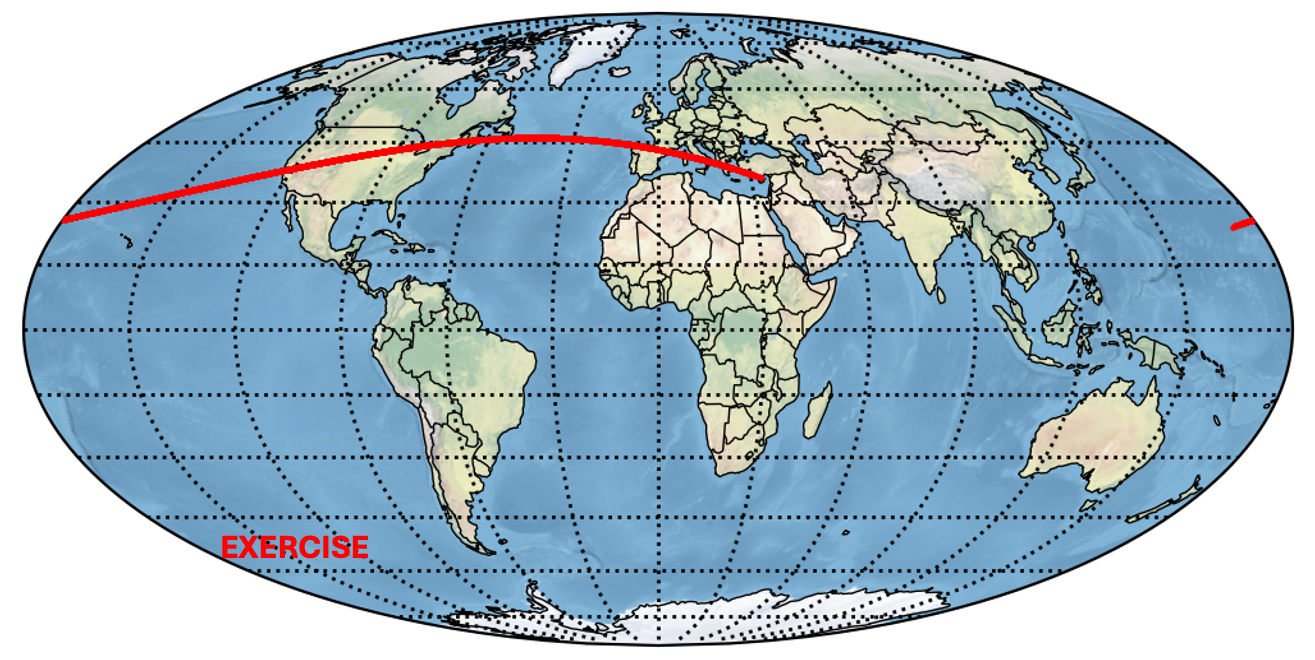
| Impact Risk Corridor | Across the Pacific Ocean, United States of America, Canada, the Atlantic Ocean, Spain, France, Italy, Greece, Turkey, and the Mediterranean Sea |
| Asteroid Size | Most likely in the range 80–85 meters (260–280 feet) in diameter, but potentially in the range 75–90 meters (250–300 feet) |
| Expected Damage Level if Impact Occurs | Local to regional blast damage from a large airburst, ranging from window breakage to potential structure collapse |
| When will there be new information? | New information will be available in December 2026 when the asteroid returns to the twilight and then night sky or if detections of the asteroid are found in archival data. The asteroid is currently unobservable. |
28 June 2026: A previously undetected near-Earth asteroid was discovered by the Panoramic Survey Telescope and Rapid Response System 1 (Pan-STARRS1), a NASA-funded telescopic survey program operated by the University of Hawaii. The asteroid was detected at apparent magnitude 21.7, a typical magnitude at which asteroids were discovered in 2026. When first detected, the asteroid was about 0.22 astronomical units (au)* (32 million kilometers or 20 million miles) from Earth. The asteroid was moving closer to Earth.
30 June 2026: Follow-up observations confirmed the discovery, which was announced by the Minor Planet Center (MPC). The MPC designated the asteroid as “2026 PDC27.” † The MPC’s initial assessment revealed that the newly detected asteroid’s orbit brings it very close to Earth’s orbit, well within 0.05 au †† (7.5 million kilometers or 4.6 million miles). NASA/JPL’s Center for Near-Earth Object Studies (CNEOS) and ESA’s Near-Earth Objects Coordination Centre (NEOCC) independently computed initial estimates of 2026 PDC27’s orbit and confirmed that its orbit brings the asteroid very close to Earth’s orbit.
Within a few days: CNEOS’s Sentry impact monitoring system and NEOCC’s Aegis impact monitoring system independently determined that asteroid 2026 PDC27 had a very small chance (about 1-in-25,000) of impacting Earth on 10 July 2038, approximately 12 years later. The impact probability was estimated from the calculated orbit and the uncertainty in that calculation. The orbit, in turn, was computed from the available measurements of the asteroid’s position in the sky and their uncertainties. In light of the small chance of a future impact with Earth, astronomers continued to observe 2026 PDC27 almost every night. These follow-up observations reduced the uncertainties in the asteroid’s trajectory and the Earth impact probability. As the set of observations grew, the orbit of 2026 PDC27 became more certain, and the estimated chance of an Earth impact in 2038 rose. The increased impact probability also triggered a search for possible serendipitous earlier images of the asteroid in archived telescope data. Initially, very little was known about 2026 PDC27’s physical properties. Based on measurements of its brightness, the absolute (intrinsic) magnitude of 2026 PDC27 was estimated to be H = 23.1 ± 0.2 and the size estimate was highly uncertain. On the Palermo Scale, a measure of an asteroid’s impact risk, the 2038 potential impact of 2026 PDC27 was rated −2.9, placing it near the top of the list of impact risks. On the 0-to-10 Torino Scale, the asteroid was initially rated 0.
8 July 2026: The impact probability reached 0.1%, corresponding to a Palermo Scale of −1.5 and a Torino Scale of 1 (green).
12 July 2026: The asteroid was detected in images taken by the NSF-DOE Vera C. Rubin Observatory in Chile on 11, 17, and 23 May and 4, 10, and 16 June 2026. The archival detections were reported to the Minor Planet Center. These detections extended the span of time covered by the observations and dramatically improved the orbital predictions for 2038. As a result, the impact probability rose to 16%. The higher impact probably led to planning for the James Webb Space Telescope (JWST) to observe the asteroid.
15 July 2026: The International Asteroid Warning Network (IAWN) issued a formal notification regarding the potential Earth impact because the probability of impact passed the 1% notification threshold established by IAWN.
16 and 17 July 2026: JWST successfully obtained infrared observations of the asteroid. As a result, the asteroid’s diameter was estimated to likely be 80–85 meters (260–280 feet), but potentially in the range 75–90 meters (250–300 feet). The JWST observations also indicated that the asteroid belongs to the S-type taxonomic class (meaning the asteroid’s material composition was likely rocky rather than metallic).
18 July 2026: The asteroid reached its minimum distance to Earth of 0.19 au (28 million km or 17 million miles) for this apparition. The asteroid remained too far away for planetary radar to detect it during this apparition.
31 July 2026: The asteroid moved too close to the Sun in the sky to remain observable, ending telescopic observations for the discovery apparition. The impact probability rose to 19%, corresponding to a Palermo Scale of +0.8 and a Torino Scale of 3 (yellow).
1 August 2026: IAWN issued a second notification because of the end of the discovery apparition and the updated information on the impact probability and the asteroid’s physical properties. The notification explained that, after the asteroid became observable again, additional observations were expected to reduce the uncertainty in its orbit, thereby shrinking the predicted uncertainty region in 2038. If Earth remained within the shrinking region, the impact probability was expected to increase; if the region moved completely off Earth, the impact probability would fall to zero.
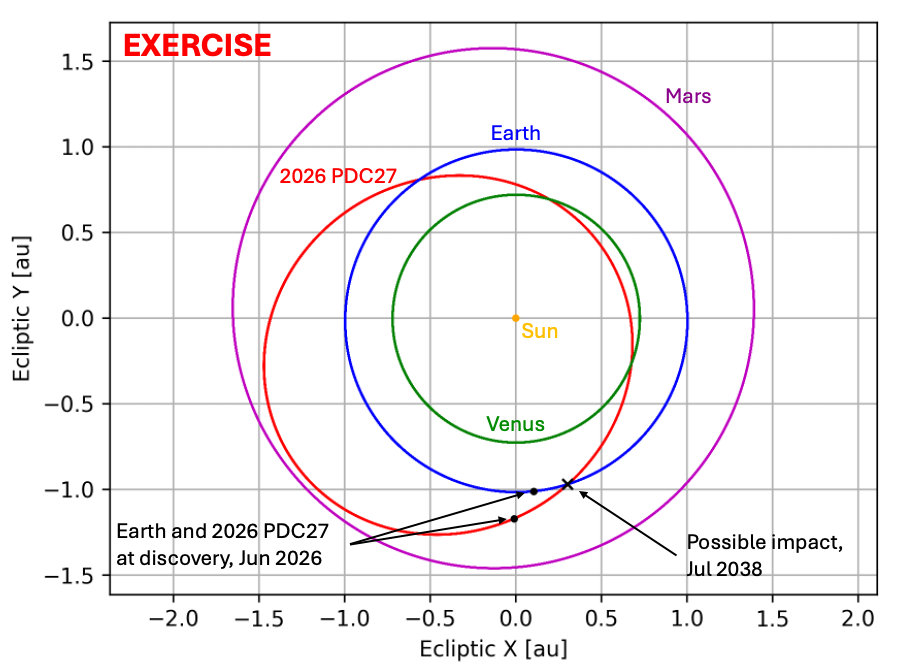
A special version of the JPL orbit viewer is available for this object. The orbit of 2026 PDC27 is moderately eccentric (eccentricity of 0.4), with a perihelion of 0.67 au and an aphelion of 1.59 au. The asteroid’s orbital period is 437 days (1.2 years). The orbit is inclined about 14 degrees to Earth’s orbital plane.
So far, 2026 PDC27 has been observed for about a month and the corresponding observations are provided in the Astrometry Data Exchange Standard (ADES) format.
The following diagram shows the orbits of 2026 PDC27 and Earth, along with their positions when the asteroid was discovered on June 28, 2026, and the point where the two orbits intersect, which is where the potential 2038 impact would occur. In this view, both the Earth and the asteroid orbit the Sun in a counterclockwise direction; the asteroid makes nearly 10 revolutions about the Sun between discovery and the potential impact, while the Earth makes roughly 12 revolutions over that interval. The orbits of Venus and Mars are also shown for reference.
|
| Orbit of asteroid 2026 PDC27 |
|
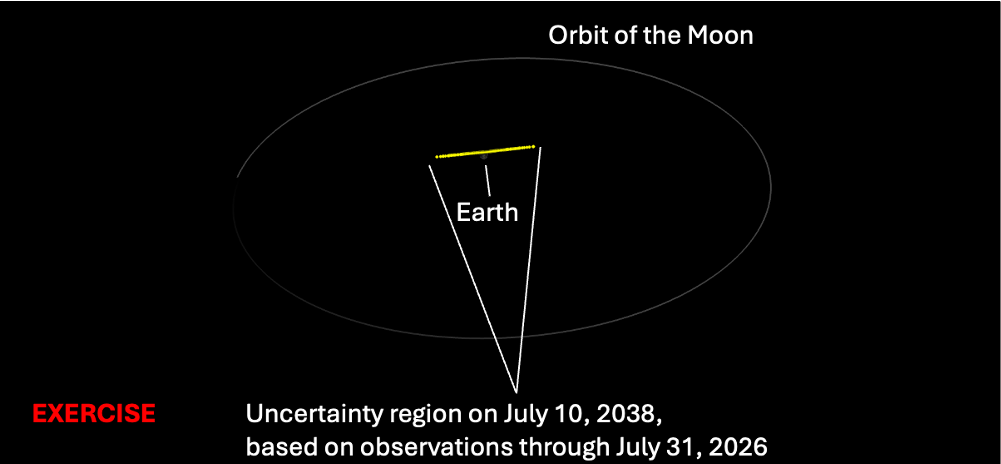
| Current uncertainty in predicted position of asteroid 2026 PDC27 on 10 July 2038, compared to the orbit of the Moon |
|
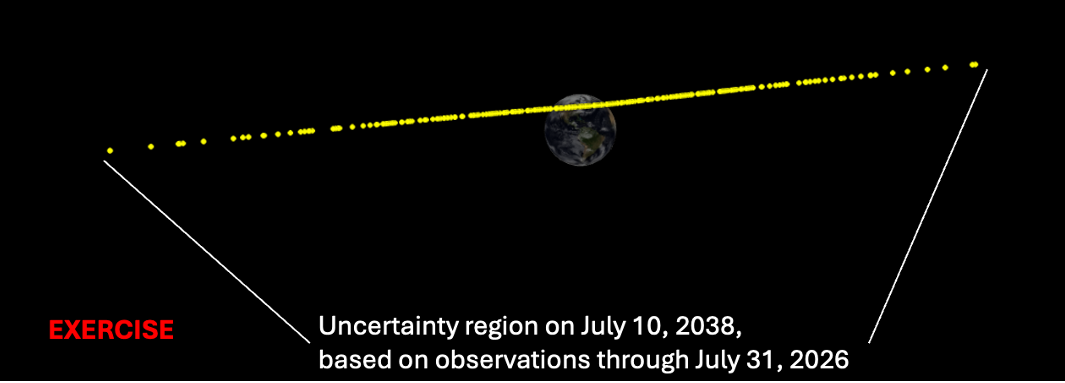
| Close-up of the current uncertainty in predicted position of asteroid 2026 PDC27 on 10 July 2038 |
|
| Risk corridor for 2026 PDC27 |
The red dots tracing the risk corridor are randomly distributed within the region. The risk corridor is a continuous region, in which the impact probability is proportional to the average areal density of the points. The points become more widely spaced toward the end of the corridor because the asteroid enters at shallower elevation angles in those regions.
The orbit for a worst-case trajectory for 2026 PDC27 has been loaded into JPL’s HORIZONS system and can be accessed via the name “2026 PDC27” or “PDC27”. The trajectory is worst-case in the sense that it passes closest to the geocenter, which would require the most deflection in order to miss the Earth compared to other possible trajectories that impact closer to the limb. In other words, this is the trajectory that impacts the encounter b-plane closest to the center of the Earth disc, as described below. HORIZONS can be accessed with this object preloaded via the web interface.
For those who wish to use SPICE Toolkit to examine the trajectory of 2026 PDC27, an SPK file has been created for the same “worst-case” orbit described above, and is available here. The SPK file is consistent with and contains additional DE441 planetary ephemeris information over the timespan 1998-Jan-01 through impact on 2038-Jul-10, permitting retrieval of object state vectors at any arbitrary instant within that timespan.
This same worst-case trajectory for 2026 PDC27, described above, has been loaded into the JPL/Aerospace Corp. NEO Deflection App. This online tool allows users to study the velocity change (delta-v) required to deflect the 2026 PDC27 trajectory away from the Earth, as a function of deflection time. A specific amount of impulsive velocity change can be applied at a specific time before impact and the resulting deflection in the impact b-plane is shown. The app can also be configured to calculate kinetic impactor spacecraft trajectories, as well as the maximum spacecraft masses that can be launched onto those trajectories by various launch vehicles. The app calculates the delta-v applied to the asteroid when one or more of those kinetic impactors hit it, as a function of asteroid size, density, and momentum enhancement factor (“beta”), and determines the Opik b-plane coordinates, xi and zeta, of the deflected trajectory during the 2038 encounter. A complete description of how to use the app is available.
Trajectories for other PDC scenarios, such as the 2019 PDC, are also loaded into the app.
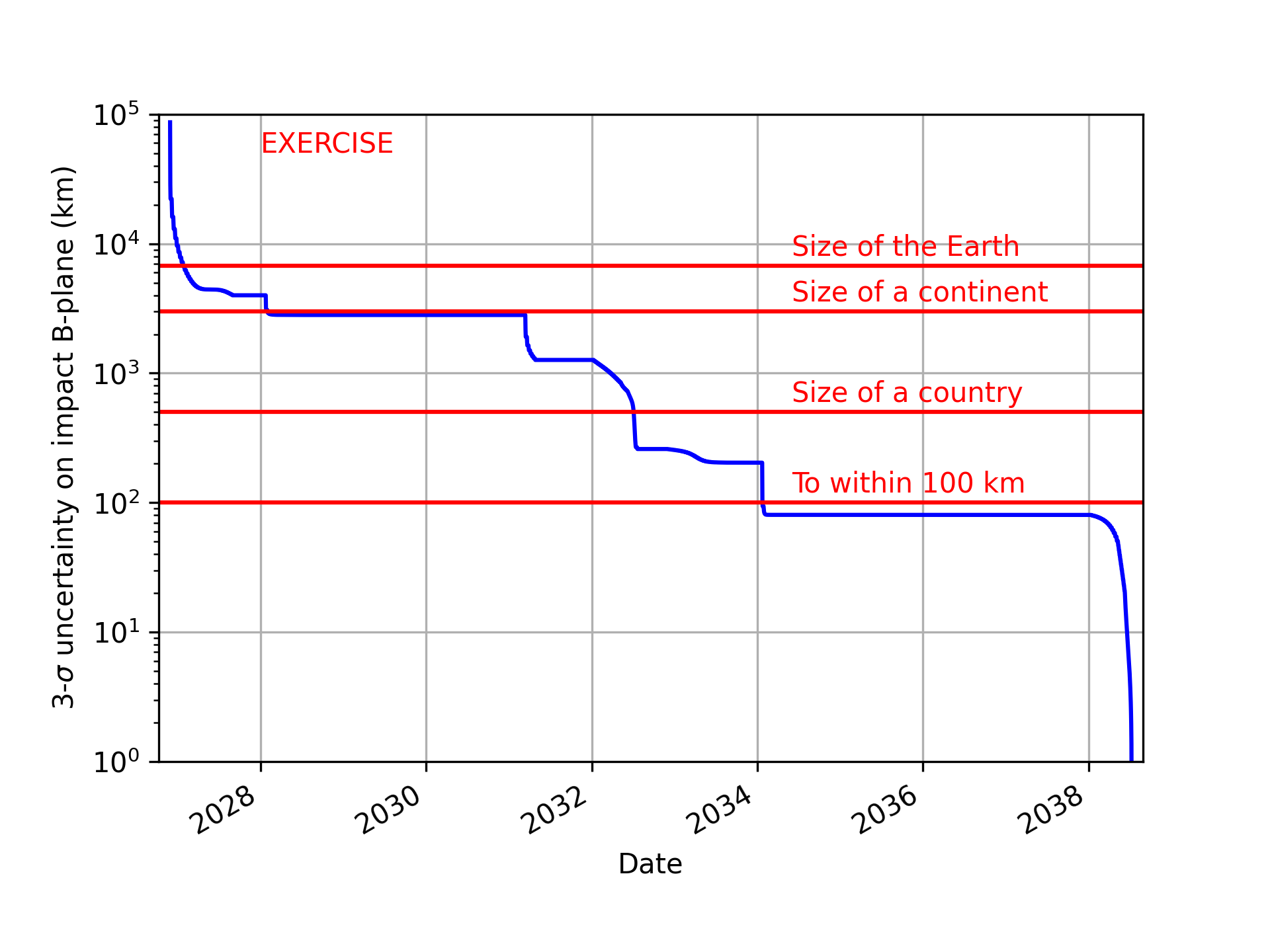
Based on anticipated ground-based observations at future apparitions, the resulting decrease in the uncertainty of the orbit of asteroid 2026 PDC27 over time can be modeled. The following figure shows the expected uncertainty on the B-plane for the July 2038 encounter (i.e., the expected uncertainty in where asteroid 2026 PDC27 will pass relative to Earth on 10 July 2038). This B-plane uncertainty will roughly correspond to the uncertainty in the asteroid’s Earth impact location, if the asteroid turns out to be on an Earth-impacting trajectory and if all of the uncertainty region intersects with the Earth.
|
| B-plane uncertainty evolution for 2026 PDC27 |
|
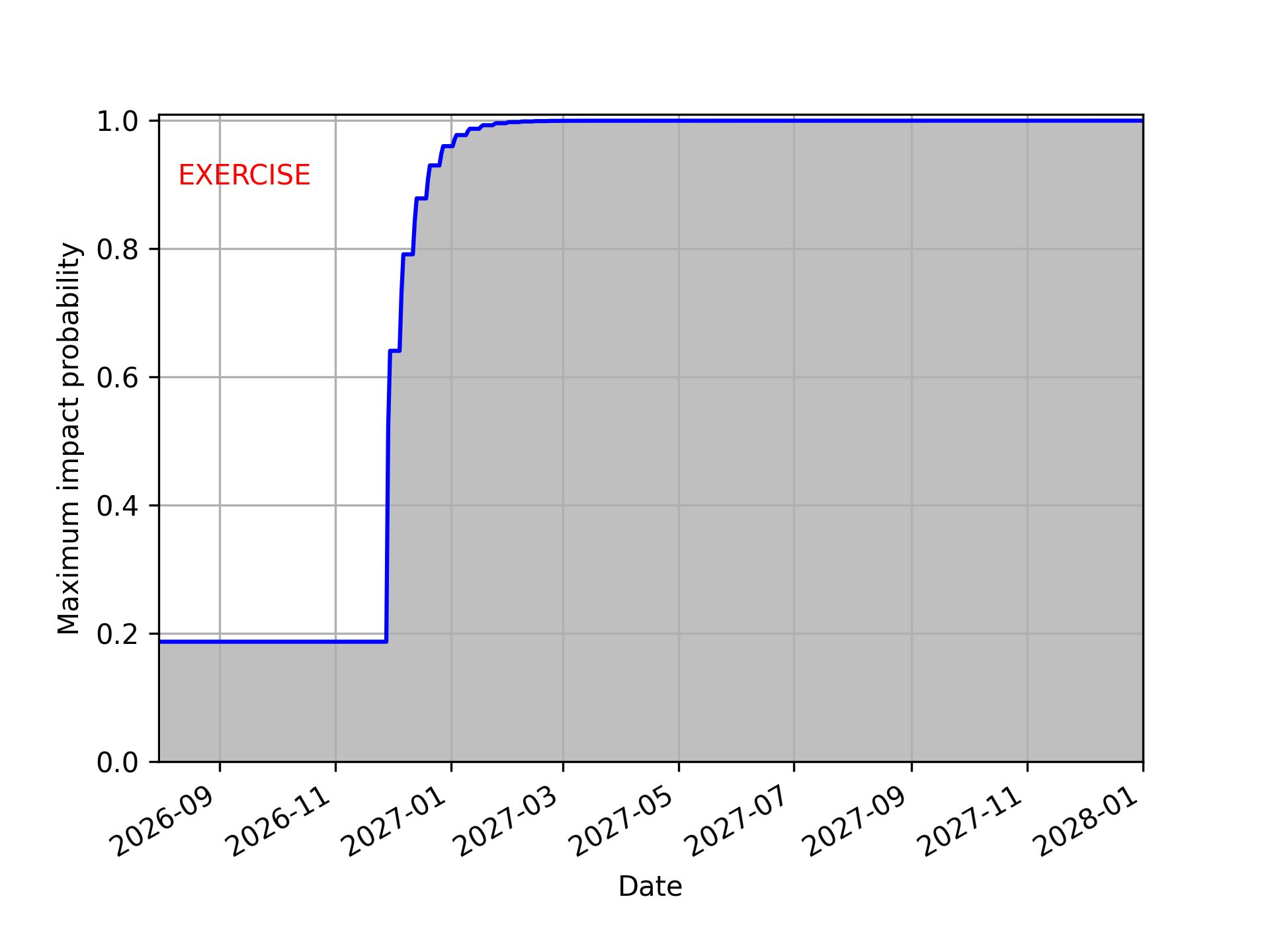
| Fastest possible increase in Earth impact probability for 2026 PDC27 |
Based on the range of possible Earth impact velocities of 2026 PDC27 in 2038 and its estimated size and taxonomy, the energy released at impact is estimated to be most likely in the range 18–32 Mt, but possibly as large as 50 Mt. The expected damage of the impact could be on the regional scale, likely extending as far as 50 kilometers from the impact location (which is not yet known) but possibly as far as 100 kilometers.
A Google Earth KMZ file of damage risk swath maps and sample damage footprints is available, along with a document describing its contents.
Uncertainty in the asteroid’s mass is the primary source of uncertainty in the projected damage.
* For those who are not familiar with the unit “au”, it stands for “astronomical unit”, which is the mean distance of the Earth from the Sun, 149,597,870.7 km, or 92,955,807 miles.
† Following the usual protocol, the designation begins with “2026”, the year the asteroid was discovered. To reinforce the fact that this is not a real asteroid, however, we are using three letters in the designation, something that would never be done for an actual asteroid. Trailing digits are often used at the end of designations to make them unique, and for this hypothetical object, we append “27” to the designation to reflect the year of the Planetary Defense Conference at which the exercise will be discussed.
†† The 0.05 au threshold on the closeness of the two orbits is one of the criteria for an asteroid to be considered “potentially hazardous”.