Four months have passed since Module 1, and the impact of 2022 TTX is now 100% certain. The impact location will be in North Carolina. The impact time can now be predicted accurately as well: August 16, 2022 at 18:02 UTC, or 2:02:10 pm EDT.
The main reason the impact can be predicted so precisely 2 months in advance is that pre-discovery tracking observations (“pre-covery detections”) were found in sky images taken in 2015, when 2022 TTX made a distant flyby of Earth. With new tracking data now spanning 7 years of orbital motion, the orbit of the asteroid is known much more accurately, and this enables much more precise predictions of the impact.
Meanwhile, over the last 4 months astronomers worldwide have continued tracking the asteroid at every opportunity, using large optical telescopes, and they have contributed close to a hundred new observations.
The predicted impact region is now quite well known: North Carolina. The following diagram shows the location of the predicted impact; the size of the impact region is roughly 130 by 100 miles (200 by 150 kilometers).
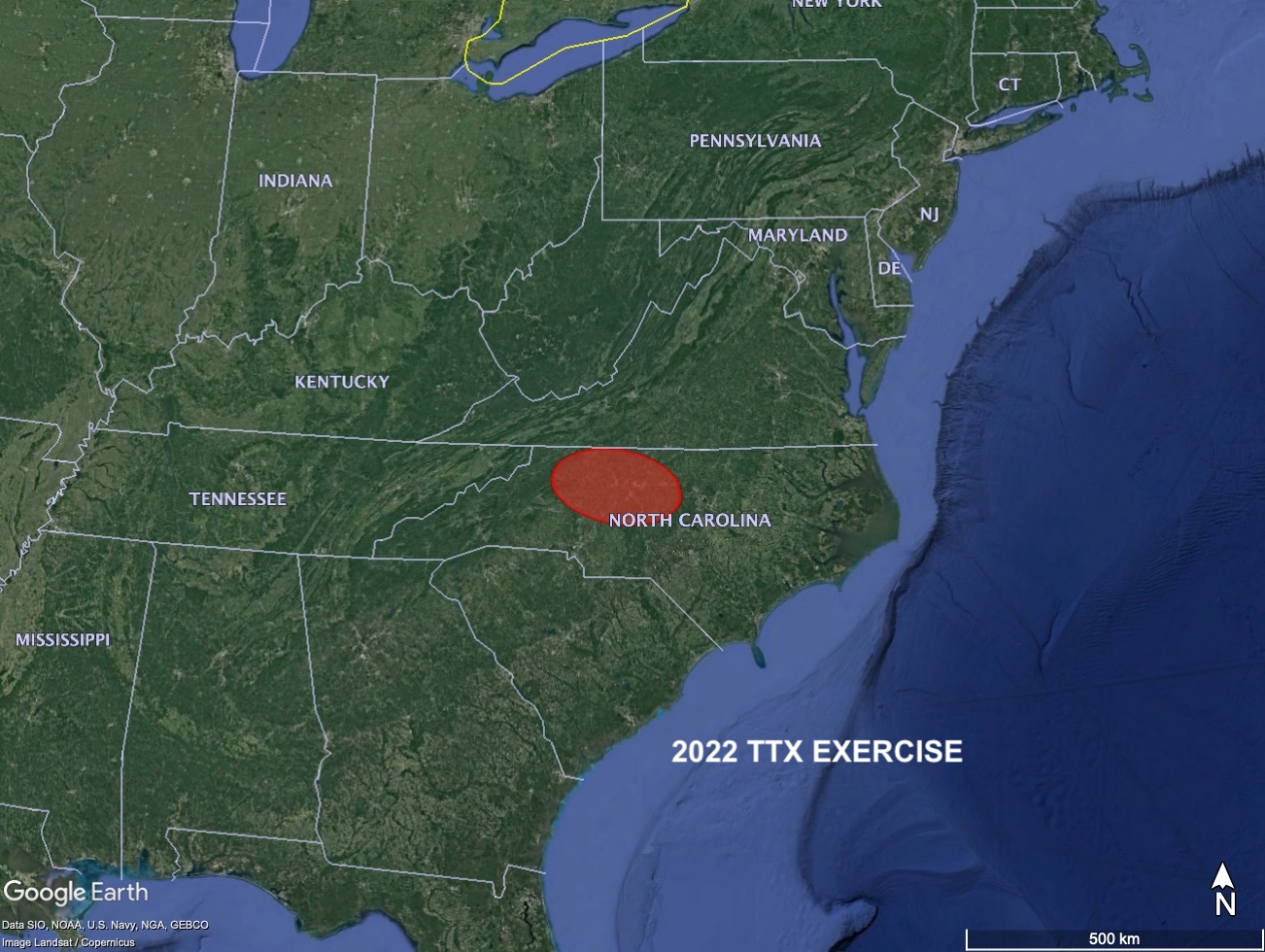
|
| This image shows the predicted impact region for 2022 TTX, as of June 15, 2022 |
A few months ago, 2022 TTX passed through the sky region where the NEOWISE spacecraft points its infra-red telescope. If the asteroid were at the large end of its size range, it should have been detected by NEOWISE. Since it was not detected, even after dozens of attempts, we conclude that the asteroid is not at the large end of the size range: it can’t be 440 meters across. An analysis of the sensitivity of NEOWISE detections indicates the asteroid must be no larger than about 340 meters (1100 ft) across.
The fact that worst-case estimates of potential damage depend on the large end of the size range, together with the fact that we are using a NON-detection of the asteroid to set the upper limit on the size, emphasizes the importance of accurately characterizing the sensitivity limits of a space-based IR sensor such as NEOWISE.
A Google Earth kml file for the impact region shown above is available here.